


Tony Castro x Boat Heroes
The latest issue of Boat Heroes features a wonderful profile of Tony Castro, written and photographed by Stéphane Gamelin. It follows his journey from a boy sketching boats in Lisbon to one of the leading names in yacht design, including the long partnership with Galeon.
It’s a warm, sharp and beautifully photographed portrait. Our sincere thanks to Stéphane Gamelin for telling the story so well, and to Boat Heroes for the feature, captured with Galeon by RCMarine.
We’re delighted to share the full article below. To discover more of Boat Heroes, visit Boat Heroes Magazine or pick up the latest issue.
As featured in Boat Heroes · September 2026
Tony Castro: from sketch to hull
He has the smile and sparkle in his eyes usually seen in happy children. Certainly because his childhood passion became his life. Tony Castro is now a leading name in yacht design. His name is inseparable from the Galeon brand, which has benefited from his long experience.
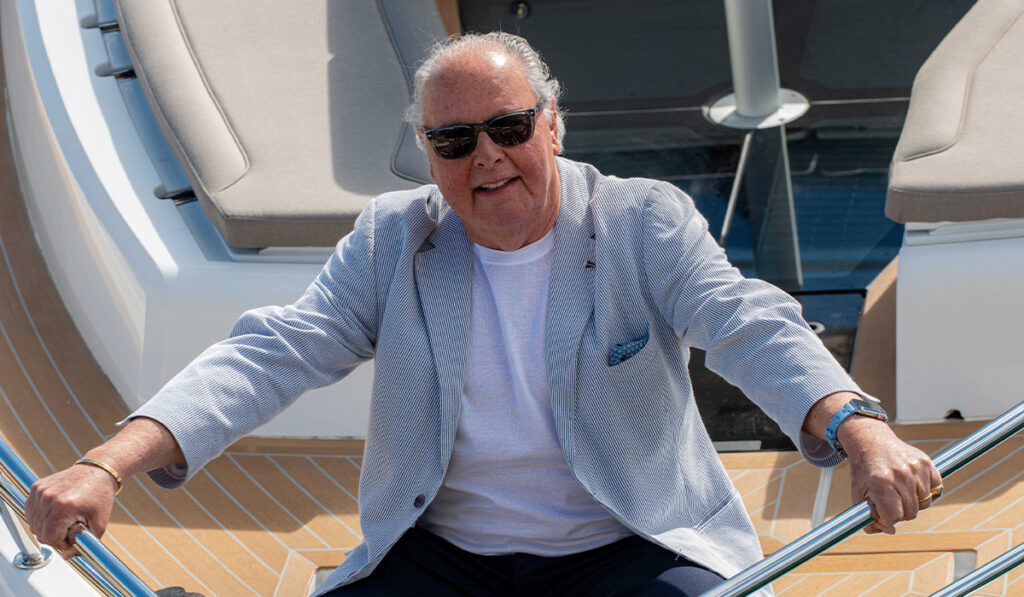
Tony Castro was born near the sea, in Lisbon, in 1952. He discovered sailing at a very young age, became involved in regattas and learned there the subtlety and importance of sailing performance. Among his childhood memories is also a love of drawing, and his unexplained urge to sketch boats. His first was the Titanic. Even then, he thought big.
But early vocations do not fulfil themselves. He moved to the United Kingdom, earned a degree in naval architecture and a master’s in aerodynamics in Glasgow, then considered one of the world capitals of naval architecture. He quickly joined the Ron Holland office, the benchmark for racing yachts in the 1970s. For him it became a school of rigour and an absolute demand for results.
He was only 28 when he founded Tony Castro Yacht Design, but he possessed the inherited boldness of his ancestor Martinho de Mello e Castro, Portugal’s Minister of the Navy and a major force behind the development of naval infrastructure at the end of the 18th century. The gamble was bold, but success came quickly, with the yacht Justine III winning the One Ton Cup, followed by other victories that propelled him onto the international stage. His reputation rests on a simple principle: his boats win.
In the 1990s came diversification. He began designing cruising yachts and motor yachts. He kept the same guiding principle: not to apply a ‘Castro style’ and spend his life drawing the same boat, but to adapt to each vessel’s project, understand it and retain a functional justification for the plans. Nevertheless, he has a reputation for challenging the rules and innovating.
This ‘Portuguese who became a British naval architect’ won over European shipyards. Jeanneau, Beneteau, Jongert, Palmer, Williams… all appreciate an office that brings together naval architects, structural engineers, 3D specialists and designers, and can therefore support a project from the first sketch through to the mould. It is equally capable of focusing on one-off custom projects or large production series, always keeping its motto: ‘Design is how it works.’
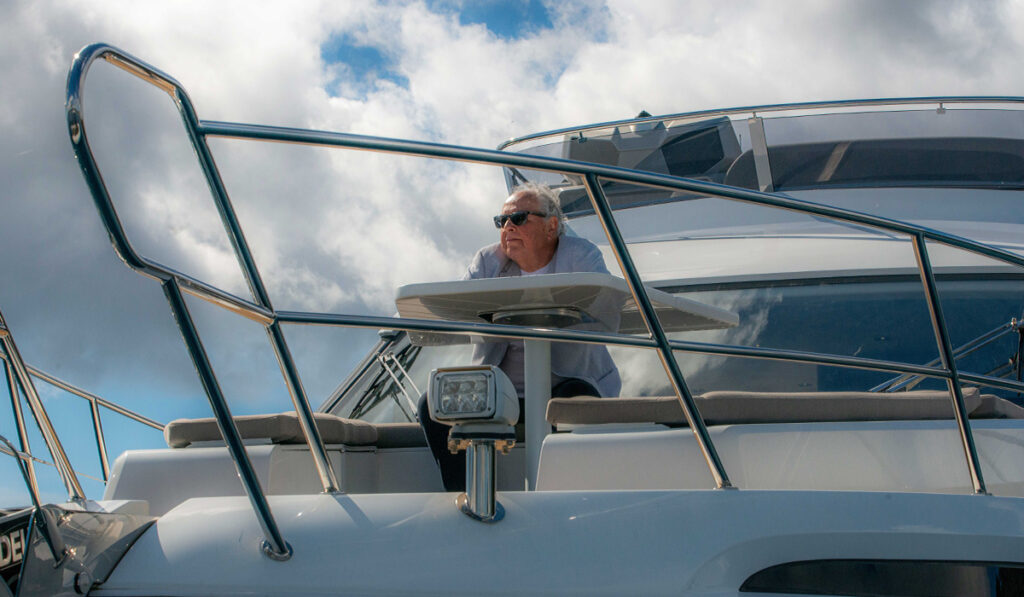
This expertise appealed to the Polish brand Galeon, still very young at the dawn of the 2000s. The British and Italians were playing in the big league. To compete with them, it would be necessary to do better, go bigger and be different. A challenge that appealed to the designer, who would not simply draw a hull, but would bring a brand identity, range segmentation and a host of innovations. In just a few years, Galeon became a credible player, a benchmark for quality.
2015 marked a turning point with the arrival of the 500 Fly. Castro introduced his stroke of genius: the fold-down side platforms, ‘Beach Mode’, which enlarge the cockpit when the boat is at rest. An idea that seems obvious today, but which no production builder had conceived – or dared to try. Add the swivelling benches and large glazed areas, and here was a shipyard that stopped following and became an innovator.
In this winning partnership, Castro brings his ideas, international experience and vision. The shipyard brings industrial capacity, commercial strength and the boldness to accept unprecedented ideas. Over 25 years, what emerged was not simply a series of individual models but an entire shipyard identity.
Today, the studio is split between two locations, Hamble in England and Cascais in Portugal. It has around forty employees, and 13,000 boats have been built to its designs. It works, of course, for Galeon, but also for other builders, designs superyachts and is involved in innovative concepts such as hybrid propulsion, assisted sails, energy footprint and even scientific exploration projects.
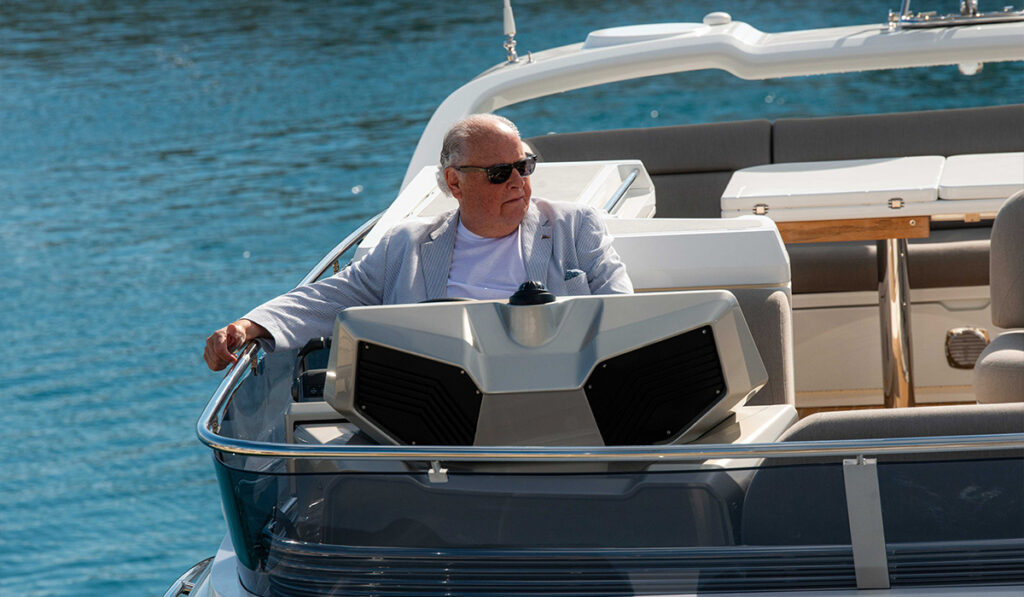
Growing up at the foot of a statue pointing towards America gives you a taste for exploration. That is how Tony Castro, himself a traveller and passionate about the polar regions, took part in the development of Pelagic, explorer Skip Novak’s vessel. He continued the idea with his ‘Yacht for Science’ concept, designing vessels in the spirit of Commander Cousteau’s Calypso, but more modern and comfortable. The idea found its way into the Galeon range with the 510 Skydeck Explorer, but in a market that was too narrow and competitive, and for which the shipyard perhaps tried too hard to preserve its style.
Tony Castro acknowledges this. ‘In the past, we imagined a boat according to a sailing programme, and then had to design its form and interior. Today, an already-conceived design has to be fitted into a hull, itself fixed by predetermined commercial constraints. What is more, every department wants to impose its choices. The original idea is often betrayed from within. It is no longer the sea that decides the boat; it is the market.’
Fortunately, our designer has sold neither his soul nor his dreams. With his innovative character, imagination and childhood love of boats, he has not finished surprising us and offering us new ways to experience the sea.
“It is no longer the sea that decides the shape of the boat; it is the market.” – Tony Castro
Words and photography: Stéphane Gamelin